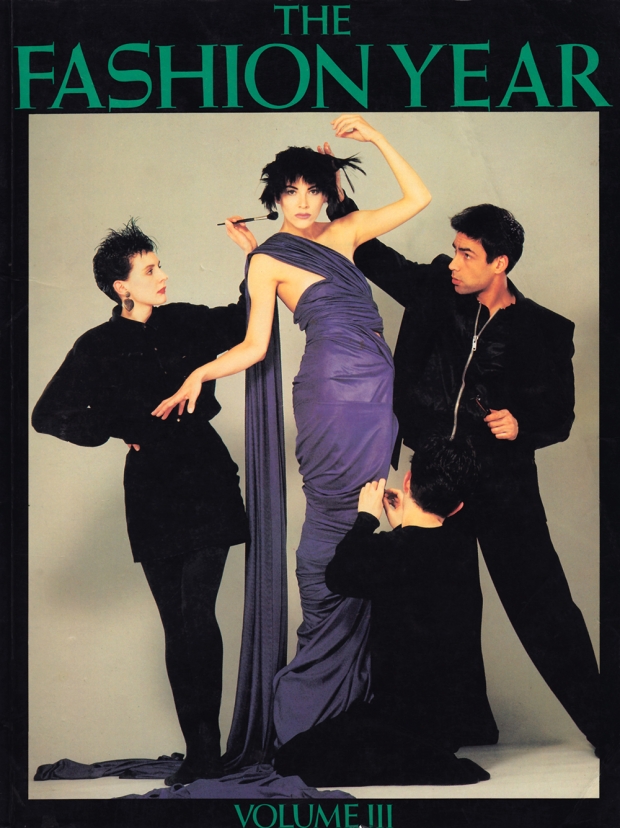
The Fashion Year, Volume III
Edited by Lorraine Johnson
Zomba Books, 160 pages, 1985
Reading through the last of The Fashion Year series I can’t help but think of how the books changed. Each was produced under a different editor, and all three brought a different style and perspective. The first volume was serious, with much catwalk and industry analysis. The second was looser, younger, more street fashion-conscious and a little bit cheeky. And in this, the third volume, we start to hear the jaded voice of the fashion journalist poke through.
The runway coverage has been demoted to a mere few pages and no analysis to speak of is offered. While the runway shots are few and teeny-tiny to boot, there are plenty of original, full-page photographs and illustrations to accompany the fashion features that make up the majority of the book.
Some of the features are hits: the behind-the-scenes looks at fashion show staging and the piece on i-D magazine, for example. Others are misses: the incomprehensible think-piece “First In: First Out — How Does it Feel to be One of the Beautiful People” and Julie Burchill’s rambling, italicized and ALL CAPS thoughts on fashion.
Generally, it’s a snarky, negative tone that pervades Volume III, and it’s a shame. Sloppy editing adds to the disappointment (designers Rifat Ozbek’s and Dorothée Bis’ names are misspelled, along with Teri Toye’s, even though there’s a feature article about the transsexual model elsewhere in the book), along with some strange editorial choices, like having Bodymap designer Stevie Stewart write about the influential fashion, music, clubs, video, dance and art of the day, but refer to herself throughout in the third-person.
There are a few bright spots, however. There’s the story that spotlights NYC up-and-comers of the day, including Todd Oldham and Marc Jacobs, and the short profiles of London trend-setters like Leigh Bowery about the clubs they go to and what they wear is good ’80s fun. But it’s a piece near the end that truly sums the book up. An interview with Diana Vreeland, who was then curator at the Metropolitan Museum of Art’s Costume Institute, it’s most amusing — and telling. She is unimpressed with the writer, who was clearly baiting her in hopes that she’d say something negative about someone or something. (My favourite bit is when he asks Mrs. Vreeland what she thinks of Dynasty’s Joan Collins and her reply is, “Who is Joan Collins?”) But Vreeland refuses to engage in any fashion-bashing and in fact calls the interviewer out for his tactics, and for that, slogging through the snark was worth it.


